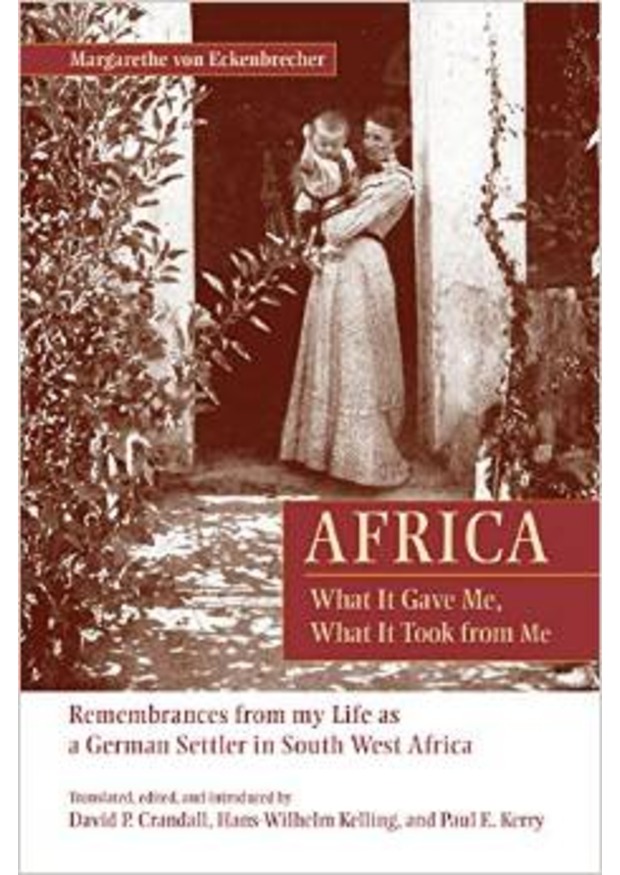
Remembrances from My Life as a German Settler in South West Africa
Margarethe von Eckenbrecher, Edited and Translated with Introduction by David P. Crandall, Hans-Wilhelm Kelling, and Paul E. Kerry
Africa: What It Gave Me, What It Took from Me is a memoir of an extraordinary woman who, as a newlywed, travelled with her husband to German South West Africa, a colony situated just above South African on the Atlantic coast. Here they begin a farm in a quite remote area where they raise cattle, sheep, and goats and plant large gardens on the banks of the Omaruru River. They build a comfortable home and welcome their first child. As the von Eckenbrechers work hard to build, their farm natives, whose land has been appropriated by the colonial government, are planning a revolt against colonial rule. Insurrection begins and the von Eckenbrechers are in the midst of it all. As the rebellion strengthens, Frau von Eckenbrecher returns to Germany to wait out the insurrection. Her husband eventually returns as well. Frau von Eckenbrecher never feels completely at home again in Germany. The von Eckenbrechers divorce and Frau von Eckenbrecher returns to South West Africa with her two sons. Her former husband emigrates to Paraguay. Frau von Eckenbrecher eventually takes a position in a German language school in Windhoek, the capital city, and rears her two sons there. In her book she chronicles colonial life, the natives of the colony, how the Spanish Influenza pandemic raged in Namibia, World War I in Africa, German surrender, and the South African occupation of German South West Africa and the eventual ceding of the colony to South Africa. We bring the memoir to a close with an update of Frau von Eckenbrecher’s later life and death, and a short remembrance from one of her two grandsons.
" This volume of essays is a wonderful tribute to the scholarly achievements of Professor Baker. "
"The volume is . . . alive with pieces that, rather than uncritically celebrating her achievements, discuss, refine, and sometimes take issue with her views."
"The Wife of Bath in Afterlife is a must-read not only for all serious-minded Chaucerian scholars but also for avid readers who earnestly endeavor to enhance their knowledge about theWife of Bath and to broaden their capacity for learning.”
-- Christina Pinkston, Norfolk State University
Review of Fiddled out of Reason, by John William Knapp
"a valuable contribution to our understanding of the hymn as a literary and cultural phenomenon."
-- Joshua Swidzinski, University of Portland
The Final Days of Edgar Allan Poe, by David F. Gaylin, has been "recommended for all readers" by Choice Reviews and was listed in their Community College Top 75 titles.
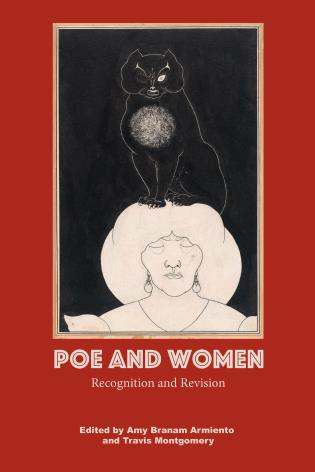
"This engaging collection redresses the balance of Poe studies to consider his work from the perspective of women, those in his works and those reading them. . . . [It] offers a welcome emphasis on the irrepressibility of women in his work who ‘die but do not stay dead’"
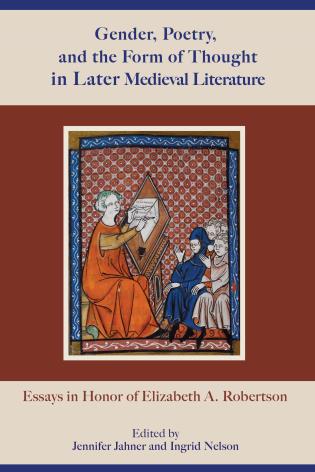
Very much in the spirit of Robertson's many impacts on our field, this collection opens a range of fascinating apertures into the medieval literary world that promise to be useful, both to fellow scholars and in a variety of literature classrooms.
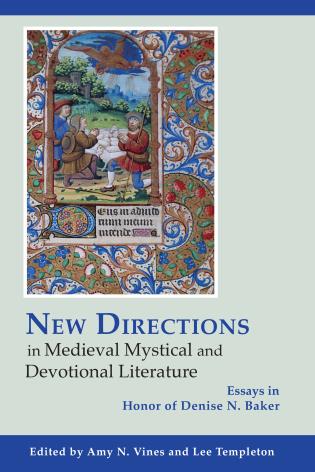
New Directions in Medieval Mystical and Devotional Literature not only makes a fitting tribute to a beloved scholar and teacher; it constitutes a significant contribution to the field in its own right. The essays in this beautifully presented book will be essential reading for anyone interested in late-medieval vernacular theology and its reception, both in England and beyond.
--Nicholas Watson, professor of English, Harvard University
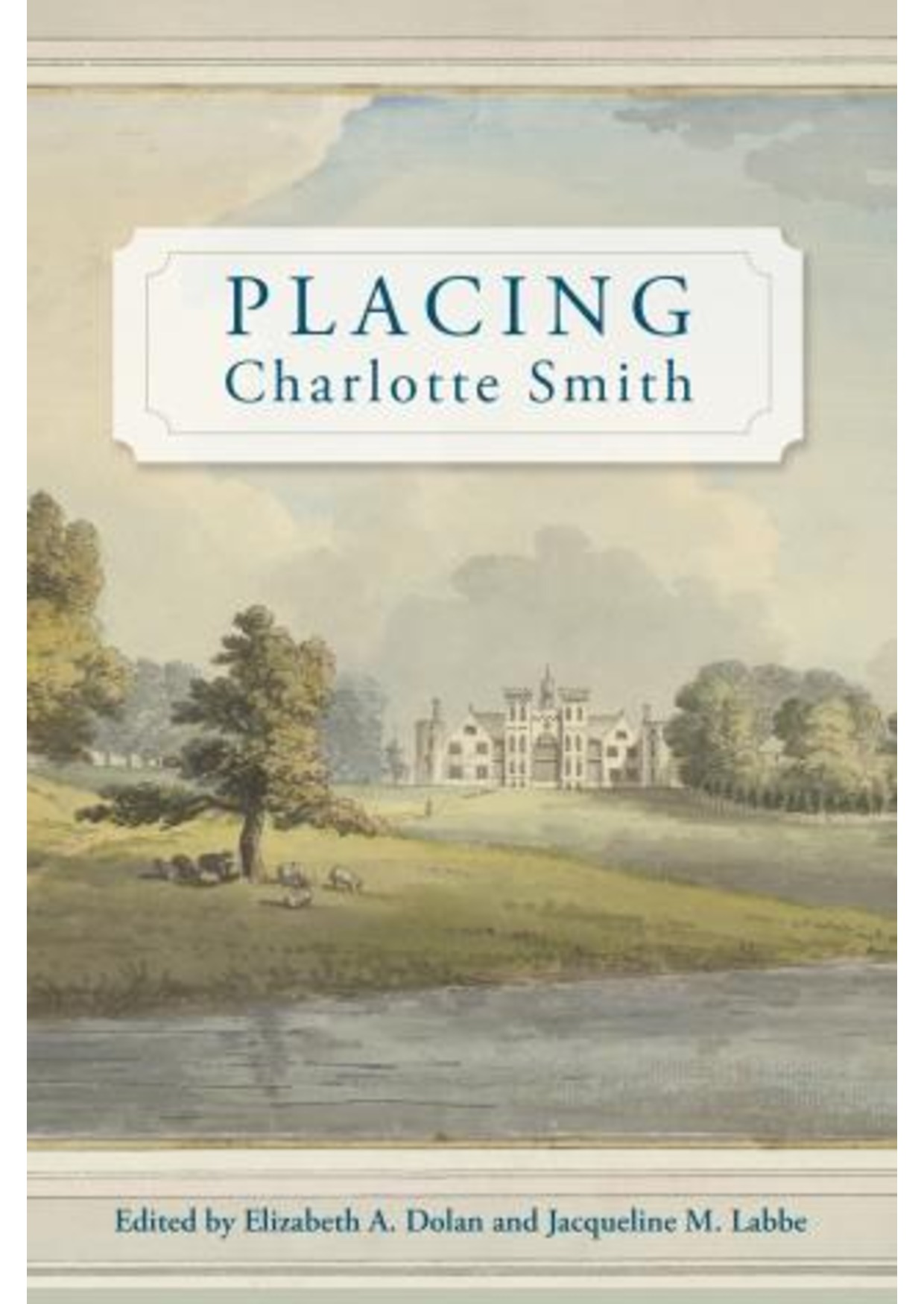
Dolan and Labbe’s wide-ranging yet cohesive collection of essays offers a comprehensive and convincing breadth that succeeds in its mission of placing Charlotte Smith. Beyond Smithian scholarship, the volume comes at a prescient time.
--Heather Heckman-McKenna University of Missouri-Columbia